Highlights
- Federated learning applied to steering angle prediction reduced the need for data transfers.
- The federated steering-angle model reduced estimated data network transfer approximately by 60%.
- Continuous model evaluation integrated as a “verifier-as-a-client” architecture.
Challenges
During industrial partnerships, cross-organizational AI development often depends on large, distributed and sensitive datasets that cannot be freely transferred to a central supercomputing environment because of privacy, security, regulatory and bandwidth constraints. Centralized training typically requires moving substantial volumes of raw data, increasing network load, storage demand, computing time and operational cost, while also exposing AI workloads and models to additional cybersecurity risks. This can limit collaboration between organizations and slow the validation of AI models on supercomputing infrastructure.
Solution
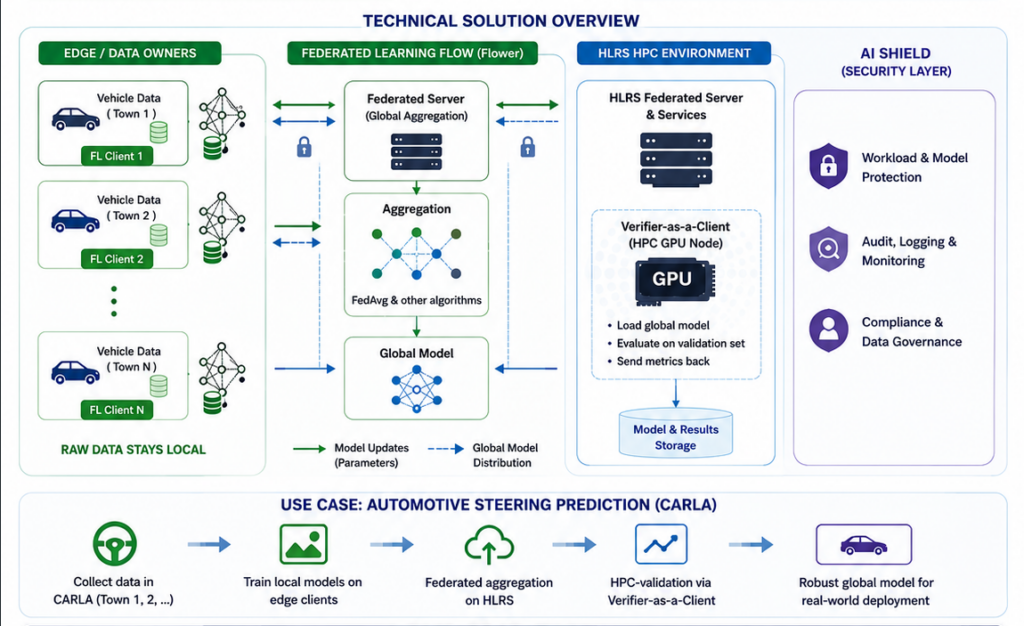
Bosch Global Software Technologies GmbH (BGSG), located in Stuttgart, Germany, develops software, digital systems, and IT solutions for enterprises. Working with HammerHAI, BGSG tested an approach that combines federated learning and secure model validation to train automotive AI models without the need to exchange raw vehicle datasets. Distributed clients trained local steering-angle models using the Flower open-source federated learning framework. No data were exchanged among clients except for model parameters, which were aggregated into a global model. HLRS GPU infrastructure provided through HammerHAI was integrated into a customized validation workflow, which included a “verifier-as-a-client” concept for evaluating global models during training. The AI security platform “AI Shield” was deployed in the HPC environment to strengthen protection of AI workloads. The approach enabled collaborative model development among data owners and sources and created a reusable edge-to-HPC workflow for secure industrial AI development and validation.
Benefits and Impact
The project demonstrated that federated learning can combine knowledge from distributed automotive datasets without requiring the transfer of the underlying raw data. Compared to a centralized approach, the federated steering-angle model prediction demonstrated significantly better generalization across operating environments, without a huge drop in accuracy. Estimated network traffic was reduced by approximately 60%, lowering bandwidth, storage and data-management requirements. Integration with the HLRS supercomputing environment established a reusable workflow for GPU-based model validation by internal teams, while AI Shield extended the approach toward securing AI workloads on HPC infrastructure.
This solution offers a scalable foundation that will make it easier for industrial partners to collaborate on the development and validation of secure AI models without exposing proprietary or sensitive data. It holds the additional benefit that reduced data movement can also decrease infrastructure load and associated energy consumption. Direct energy or monetary savings were, however, not measured in this project.
Next Steps
As the project continues, it will investigate approaches for scaling the federated workflow to include more edge and mobile clients, automating MLOps workflows in the HLRS infrastructure, and hosting reusable aggregation services on the supercomputing platform. Further work will look at strengthening cybersecurity integration with HPC, and extend the approach to broader domain agnostic AI use cases.
Contact
Rane Abhijeet, Bosch Global Software Technologies GmbH,
Abhijeet.Rane@in.bosch.com