Success Story: Accelerating AI Robot Planning with Large Language Models

—

by

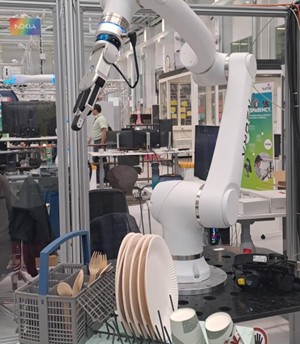
Picture showing a robotic arm in a production hall.

Highlights

  • Reduced average inference latency from 9.03 seconds to 3.98 seconds.
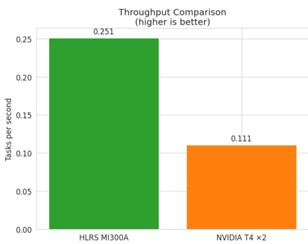
  • Achieved more than 2× higher throughput.
  • Enabled benchmarking and scalable testing of open-source LLMs for industrial robotics.

Challenges

ARENA2036 stands for “Active Research Environment for the Next generation of Automobiles” and is one of nine research campuses of the “Research Campus – Public-Private Partnership for Innovation” funding initiative in Germany. ARENA2036 is supported by the Federal Ministry of Research, Technology and Space and is run as a registered association with members from science and industry. These members are active in various disciplines – from the automotive industry to aerospace technology, textile and materials research to ergonomics. Programming industrial robots traditionally relies on manually designed rule-based systems that are difficult to scale. Large Language Models offer a new paradigm by translating natural-language instructions into executable robot actions, but evaluating hundreds of planning tasks requires substantial computational resources.
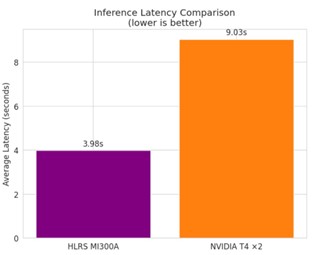
Picture showing a diagramm and HLRS MI300A with 3,98s and NVIDIA T4x2 and 9.03s.
Picture showing a diagramm and "Throughput Comparison (higher is better)" and HLRS MI300A with 0.251 and NVIDIA T4x2 and 0.111

Solution

Through HammerHAI, ARENA2036 leveraged the HLRS Hunter supercomputer to benchmark an LLM-based robot task planning framework using DeepSeek-Coder. Hunter enabled large-scale evaluation across 90 manipulation tasks comprising 450 robot actions, providing the computational performance required for systematic benchmarking and optimization. HammerHAI provided the computational infrastructure that transformed experimental AI concepts into scalable industrial solutions.

Benefits and Impact

Using HLRS Hunter, average inference latency was reduced from 9.03 s to 3.98 s, with more than 2× higher throughput across a benchmark of 90 tasks and 450 robot actions. HammerHAI enables scalable evaluation of LLM-based robotic intelligence without requiring companies to build dedicated AI computing infrastructure. Through AI-MATTERS, these approaches can be tested in realistic industrial robotics environments before deployment.

Organizations Involved

Logo for Neura Robotics.

Logo for KUKA.

Logo for RoboDK.

Logo for UNSW Sydney.
Logo Swinburne. Swinburne University of Technology.

Logo for FARO Ametek.

Logo BOW For all Robotics.

Logo OLO.
Logo for the University of Stuttgart.

Logo of HLRS (Höchstleistungsrechenzentrum Stuttgart). The abbreviation letters in black are accompanied only by a light blue computer cursor symbol (a vertical bar with horizontal lines extending from the top and bottom) in between the R and the S.

Logo of the HammerHAI project. Above the project title (with "Hammer" in black and "HAI" in three different shades of blue) three slightly curved lines in the same shades of blue remind the viewer of a hammerhead shark - the namesake of the project in German.

AI Matters logo

Contact

Muhammad Saeed, ARENA2036, muhammad.saeed@arena2036.de

Funding

The acquisition and operation of the EuroHPC Al-optimised supercomputer is funded jointly by the EuroHPC Joint Undertaking, through the European Union’s Digital Europe Programme, as well as by the German Federal Ministry of Research, Technology and Space (BMFTR) and the Baden-Württemberg Ministry of Science, Research and the Arts.

Views and opinions expressed are those of the author(s) only and do not necessarily reflect those of the European Union or the EuroHPC JU. This project has received funding from the European High Performance Computing Joint Undertaking under grant agreement No. 101234027. It is co-funded by the European Commission, the German Federal Ministry of Research, Technology and Space (BMFTR), the Baden-Württemberg Ministry of Science, Research and the Arts, the Bavarian State Ministry of Science and the Arts and the Lower Saxony Ministry of Science and Culture.

Logo of the Federal Ministry of Research, Technology and Space of Germany. A black eagle icon (coat of arms of Germany) on the left, a vertical strip in the colors of the German flag (black, red, yellow) to the right of it and even further to the right the wordmark "Bundesministerium für Forschung, Technologie und Raumfahrt".