
Success Stories
- Success Story: Securing AI across the Machine Learning Operations chain: Piloting cybersecurity and data sovereignty of AI in supercomputing
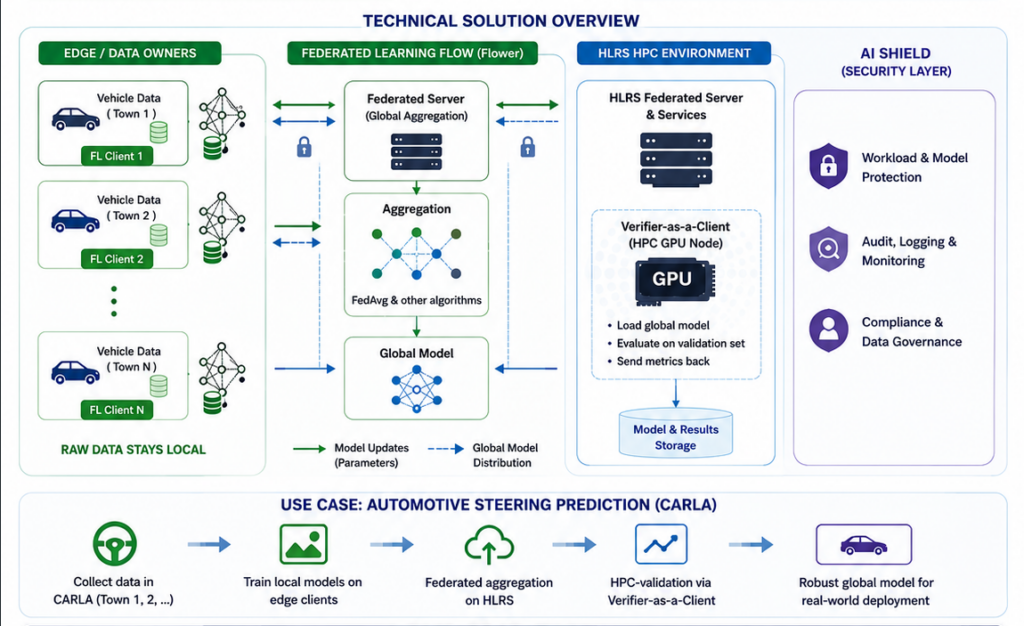 Working with HammerHAI, Bosch Global Software Technologies GmbH tested an approach that combines federated learning and secure model validation to train automotive AI models without the need to exchange raw vehicle datasets. HLRS GPU infrastructure provided through HammerHAI was integrated into a customized validation workflow.
- Success Story: Testing a RAG Prototype with Real Engineering Questions
 The Material Testing Institute (MPA), University of Stuttgart, developed a retrieval-augmented generation (RAG) prototype. The collaboration with HammerHAI included a roadmapping and benchmark tests to see where the RAG prototype helps, where it fails, and how much expert review is required before industrial use could be considered.
- Success Story: Accelerating Real-Time Shopfloor Intelligence with HammerHAI
 ARENA2036 reduced model training time from 6 to 8 hours to less than one hour, supported AI applications in manufacturing, robotics, and digital twins and enabled industrial testing of AI-based shopfloor intelligence. Through the HammerHAI project, ARENA2036 gained access to the HLRS Hunter supercomputer.
- Success Story: GenCAD – Foundation Model for Engineering Design GenerationARENA2036 accelerated development and training of a generative AI framework for Computer-Aided Design (CAD) and enabled training on large engineering datasets. Through the HammerHAI project, ARENA2036 utilized the High-Performance Computing Center Stuttgart (HLRS) Hunter supercomputer to accelerate the development and training of GenCAD, a generative AI framework for computer-aided design.
- Success Story: Accelerating AI Robot Planning with Large Language ModelsARENA2036 reduced average inference latency from 9.03 seconds to 3.98 seconds and achieved more than 2× higher throughput. Through HammerHAI, ARENA2036 leveraged the HLRS Hunter supercomputer to benchmark an LLM-based robot task planning framework using DeepSeek-Coder.
- User Story: Bridging Simulation and Reality for Safer Autonomous Driving
 cogniBIT’s goals are to convert driving simulations into photorealistic video and scale synthetic data generation to support verification and validation of autonomous vehicles. Collaboration with HammerHAI includes simulation outputs and initial experiments using existing GPU resources at the High-Performance Computing Center Stuttgart (HLRS).
- User Story: Training Europe’s Construction Embedding AI with HammerHAI
 flinq is looking for continuous access to GPUs that can scale with a transition from today’s fine-tuning experiments to the significantly larger training runs for new models that lie ahead. flinq has been onboarded and has access to KISSKI (AI service center for critical and sensitive infrastructures).
- User Story: JAWS: Anticipating Industrial Operating Conditions from Point-of-View Video
 Ramblr GmbH is developing JAWS, an AI technology to anticipate future scene graphs and process states from point-of-view industrial video. JAWS has been approved for the HammerHAI training platform, provided through KISSKI (AI service center for critical and sensitive infrastructures).
Stay informed
HammerHAI is growing! Subscribe to our newsletter for periodic updates and be among the first to learn about our newest services, resources, and activities:
You can also follow HammerHAI on LinkedIn, BlueSky and YouTube.