Highlights
- Accelerated development and training of a generative AI framework for Computer-Aided Design (CAD).
- Enabled training on large engineering datasets.
- Supported model optimization and robustness evaluation.
Challenges
ARENA2036 stands for “Active Research Environment for the Next generation of Automobiles” and is one of nine research campuses of the “Research Campus – Public-Private Partnership for Innovation” funding initiative in Germany. ARENA2036 is supported by the Federal Ministry of Research, Technology and Space and is run as a registered association with members from science and industry. These members are active in various disciplines – from the automotive industry to aerospace technology, textile and materials research to ergonomics. Generative AI is rapidly transforming engineering design by enabling AI models to automatically generate, understand, and optimize CAD models from limited inputs such as sketches, point clouds, or natural-language descriptions. Training these large foundation models requires processing millions of geometric primitives and complex 3D representations, resulting in computational demands that exceed conventional workstation hardware.
Solution
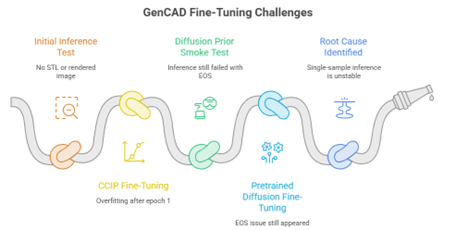
Through the HammerHAI project, ARENA2036 utilized the High-Performance Computing Center Stuttgart (HLRS) Hunter supercomputer to accelerate the development and training of GenCAD, a generative AI framework for computer-aided design. Hunter’s scalable computing resources enabled efficient training of deep neural networks on large engineering datasets while significantly reducing model development time. The supercomputing environment also allowed extensive experimentation with model architectures, hyperparameter optimization, and large-scale benchmarking that would have been impractical using local GPU resources. HammerHAI transformed what had previously been resource-constrained experimentation into a scalable AI development workflow and provided the computational backbone that enabled this next generation of engineering AI research.
Benefits and Impact
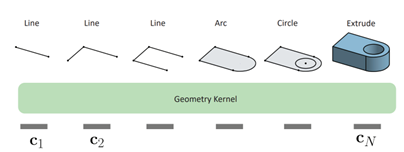
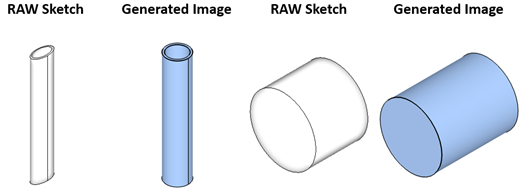
GenCAD represents an important step toward AI-assisted engineering design and digital product development. The technology has strong potential for automated CAD generation, design optimization, digital engineering, and future industrial AI assistants. Through AI-MATTERS, these capabilities can be demonstrated and validated with industrial partners, accelerating the adoption of generative AI in manufacturing and product development. HammerHAI provided the computational backbone that enabled this next generation of engineering AI research. Using HLRS Hunter, GenCAD training became more scalable, supporting larger engineering datasets and systematic evaluation of different model and design-generation strategies. HammerHAI enables companies to explore compute-intensive Generative AI for engineering without making major upfront investments in dedicated HPC infrastructure. Through AI-MATTERS, resulting Proofs of Concept can be tested with industrial partners before larger deployment decisions
Organizations Involved




Contact
Muhammad Saeed, ARENA2036, muhammad.saeed@arena2036.de