Success Story: Accelerating Real-Time Shopfloor Intelligence with HammerHAI

—

by

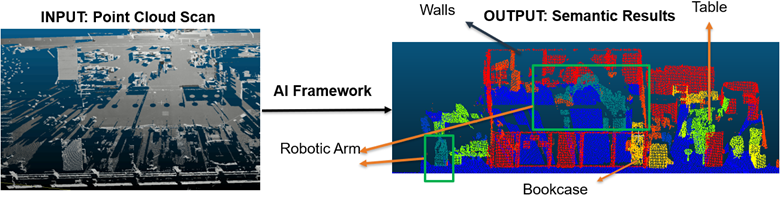
Graphic showing an input point cloud scan processed by an AI framework for a robotic arm, producing semantic results identifying objects such as walls, a table, and a bookcase.

Highlights

  • Reduced model training time from 6–8 hours to less than one hour.
  • Supported AI applications in manufacturing, robotics, and digital twins.
  • Enabled industrial testing of AI-based shopfloor intelligence.

Challenges

ARENA2036 stands for „Active Research Environment for the Next generation of Automobiles“ and is one of nine research campuses of the „Research Campus – Public-Private Partnership for Innovation“ funding initiative in Germany. ARENA2036 is supported by the Federal Ministry of Research, Technology and Space and is run as a registered association with members from science and industry. These members are active in various disciplines – from the automotive industry to aerospace technology, textile and materials research to ergonomics. Modern manufacturing environments generate vast amounts of spatial data that must be processed in real time to support robotics, autonomous systems, and digital twins. At ARENA2036, we developed a deep-learning-based Shopfloor Model capable of mapping, segmenting, and classifying industrial environments. However, training these large neural networks on local GPU workstations required overnight computation (6–8 hours), significantly slowing research iterations and limiting rapid model optimization.

Solution

Through the HammerHAI project, ARENA2036 gained access to the HLRS Hunter supercomputer, enabling the migration of our training pipeline from sequential local execution to a highly optimized parallel multi-node supercomputing environment. Hunter’s scalable computing resources accelerated deep learning workflows while maintaining reproducible training across large datasets. HammerHAI provided the computational foundation that made this acceleration possible.

Benefits and Impact

The accelerated Shopfloor Model now serves as a key building block for intelligent manufacturing, robotic navigation, and digital twin applications. Through AI-MATTERS, these technologies are being transferred into industrial testing and experimentation services, allowing companies to evaluate AI-based shopfloor intelligence in realistic production environments.

Using HLRS Hunter, model training time was reduced from 6–8 hours to less than one hour, enabling significantly faster experimentation and validation. Through HammerHAI, companies can access the required HPC capabilities without investing upfront in dedicated computing infrastructure. Combined with AI-MATTERS, the solution can be tested in realistic manufacturing environments, reducing the technical and financial risks of industrial AI adoption.

Organizations Involved

Logo for the University of Stuttgart.

Logo of HLRS (Höchstleistungsrechenzentrum Stuttgart). The abbreviation letters in black are accompanied only by a light blue computer cursor symbol (a vertical bar with horizontal lines extending from the top and bottom) in between the R and the S.

Logo of the HammerHAI project. Above the project title (with "Hammer" in black and "HAI" in three different shades of blue) three slightly curved lines in the same shades of blue remind the viewer of a hammerhead shark - the namesake of the project in German.

Logo of SICOS. To the left of the gray wordmark a light blue rhombus of a mobius strip can be seen.
Logo for FARO Ametek.

Logo Swinburne. Swinburne University of Technology.

AI Matters logo

Contact

Muhammad Saeed, ARENA2036, muhammad.saeed@arena2036.de

Förderung

Die Beschaffung und der Betrieb des KI-optimierten EuroHPC-Supercomputers werden gemeinsam von der EuroHPC Joint Undertaking über das Programm „Digitales Europa“ der Europäischen Union sowie vom Bundesministerium für Forschung, Technologie und Raumfahrt (BMFTR) und dem Ministerium für Wissenschaft, Forschung und Kunst Baden-Württemberg gefördert.

Die geäußerten Ansichten und Meinungen sind ausschließlich die der Autorinnen und Autoren und spiegeln nicht zwangsläufig die der Europäischen Union oder der EuroHPC JU wider. Dieses Projekt wird von der European High Performance Computing Joint Undertaking im Rahmen der Fördervereinbarung Nr. 101234027 gefördert. Dieses Projekt wird von der Europäischen Kommission, dem Bundesministerium für Forschung, Technologie und Raumfahrt (BMFTR), dem Ministerium für Wissenschaft, Forschung und Kunst des Landes Baden-Württemberg, dem Bayerischen Staatsministerium für Wissenschaft und Kunst und dem Niedersächsischen Ministerium für Wissenschaft und Kultur kofinanziert.

Logo of the Federal Ministry of Research, Technology and Space of Germany. A black eagle icon (coat of arms of Germany) on the left, a vertical strip in the colors of the German flag (black, red, yellow) to the right of it and even further to the right the wordmark "Bundesministerium für Forschung, Technologie und Raumfahrt".