
Highlights
- Reduced model training time from 6–8 hours to less than one hour.
- Supported AI applications in manufacturing, robotics, and digital twins.
- Enabled industrial testing of AI-based shopfloor intelligence.
Challenges
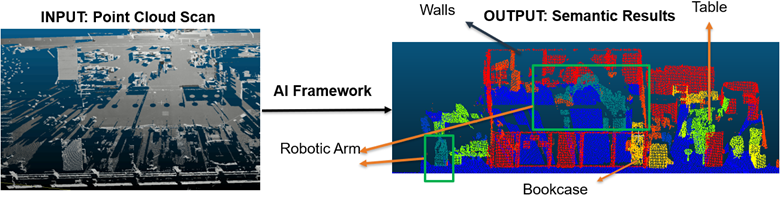
ARENA2036 stands for “Active Research Environment for the Next generation of Automobiles” and is one of nine research campuses of the “Research Campus – Public-Private Partnership for Innovation” funding initiative in Germany. ARENA2036 is supported by the Federal Ministry of Research, Technology and Space and is run as a registered association with members from science and industry. These members are active in various disciplines – from the automotive industry to aerospace technology, textile and materials research to ergonomics. Modern manufacturing environments generate vast amounts of spatial data that must be processed in real time to support robotics, autonomous systems, and digital twins. At ARENA2036, we developed a deep-learning-based Shopfloor Model capable of mapping, segmenting, and classifying industrial environments. However, training these large neural networks on local GPU workstations required overnight computation (6–8 hours), significantly slowing research iterations and limiting rapid model optimization.
Solution
Through the HammerHAI project, ARENA2036 gained access to the HLRS Hunter supercomputer, enabling the migration of our training pipeline from sequential local execution to a highly optimized parallel multi-node supercomputing environment. Hunter’s scalable computing resources accelerated deep learning workflows while maintaining reproducible training across large datasets. HammerHAI provided the computational foundation that made this acceleration possible.
Benefits and Impact
The accelerated Shopfloor Model now serves as a key building block for intelligent manufacturing, robotic navigation, and digital twin applications. Through AI-MATTERS, these technologies are being transferred into industrial testing and experimentation services, allowing companies to evaluate AI-based shopfloor intelligence in realistic production environments.
Using HLRS Hunter, model training time was reduced from 6–8 hours to less than one hour, enabling significantly faster experimentation and validation. Through HammerHAI, companies can access the required HPC capabilities without investing upfront in dedicated computing infrastructure. Combined with AI-MATTERS, the solution can be tested in realistic manufacturing environments, reducing the technical and financial risks of industrial AI adoption.
Organizations Involved





Contact
Muhammad Saeed, ARENA2036, muhammad.saeed@arena2036.de