11 Teams Tackle Real-World AI Challenges
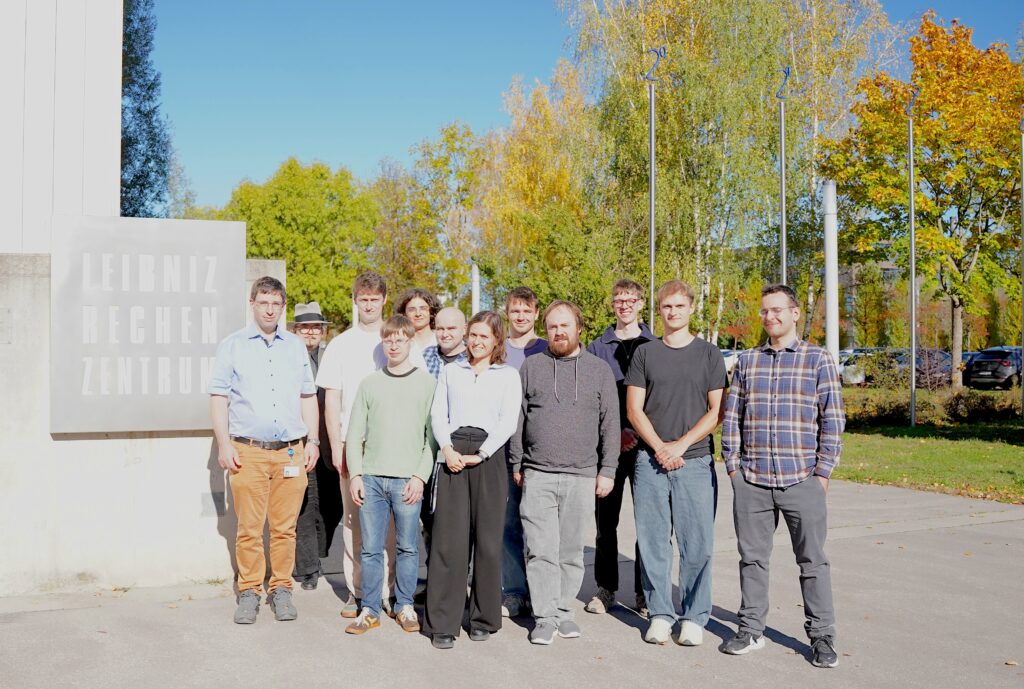
From drug development and IT security to renewable energy and autonomous transportation, the European AI Hackathon brought together teams tackling practical AI challenges. Running from October 6–29, 2026, the hackathon combined online participation with opportunities for teams to meet in person at Leibniz Supercomputing Centre (HLRZ) and High-Performance Center Stuttgart (HLRS). It supported teams with AI expert mentoring and access to advanced computing resources to benchmark their approaches, explore scalability, and test hardware.
The hackathon brought together AI Factories and AI ecosystem partners, demonstrating how collaboration across the European AI ecosystem can support teams in developing AI solutions. It was co-organized by Austrian Scientific Computing (ASC), the Leibniz Supercomputing Centre (LRZ), the High-Performance Computing Center Stuttgart (HLRS), the Academic Computer Centre Cyfronet AGH (Cyfronet), OpenACC organization, and NVIDIA for AI Factory Austria AI:AT, HammerHAI, Gaia AI Factory and AI Factory Antenna Cyprus Pharos-CY.
Of the 64 applicants, 11 teams were selected to develop AI solutions to their chosen challenges. They received guidance from AI experts and access to advanced computing resources, including Leonardo at CINECA, NVIDIA’s Curiosity cluster, and the LRZ AI systems.
AI applications across industries
The 11 selected teams, representing companies, research organizations, and academia, explored AI applications across a range of fields, including drug development, IT security, renewable energy, and autonomous transportation. Their projects included studying how AI agents interact with security safeguards, predicting wind conditions at wind turbines, detecting solar panels on Austrian rooftops from satellite images, and forecasting electricity generation. Teams also developed AI applications for service stations serving autonomous electric trucks. Five teams, supported by Austria’s AI Factory AI:AT and NVIDIA, worked on topics such as source-code conversion, weather modeling, and IT security. Together, the projects demonstrate how AI can support practical applications across industry and research.
HammerHAI contributed expertise from across its consortium. Dr. Junghwa Lee contributed expertise from HLRS, while Benedikt Pirker, Dr. David Wifling, and Dr. Michael Walther supported the event from HammerHAI consortium partner LRZ. Together, they brought the knowledge and experience of the HammerHAI consortium to the teams and their practical AI projects. This reflects HammerHAI’s role in helping startups, SMEs, industry, and academia develop, train, test, and deploy AI solutions with access to computing resources and expert support.
The European AI Hackathon highlighted the value of collaboration between AI Factories and AI ecosystem partners across Europe. We thank everyone involved for making the event possible and supporting the participating teams. We look forward to building on these connections and helping more businesses explore AI with access to expertise and advanced computing resources.